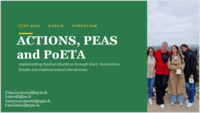
Evermore wellbeing for teens: Evidence-based foundations for the PEAS approach
Emotion, apprentissages et bien-être à l'école
- Lucciarini, Elena HEP-VS
- Benini, Sara
- Boniwell, Ilona
- Marcionetti, Jenny
- Audrin, Catherine
- Bressoud, Nicolas
- Gay, Philippe
- Burel, Nicolas
- 2026
English
This symposium explores how evidence-based positive psychology interventions can be adapted, translated, and implemented in schools. The Positive Education Actions in Schools (PEAS) project has led to the development of short, flexible, stand-alone, evidence-based interventions adapted to the school context. These have been described in a multilingual manual for teachers and other school professionals.
Anchored in scientific research and grounded in classroom realities, PEAS bridges the gap between meta-analytic evidence, pedagogical practice, and teacher training. The session begins with Boniwell’s theoretical presentation on the ACTIONS framework (Activity, Calming, Identity, Optimism, Nourrishing and Social) underpinning both PoETA (Positive Education Actions in School) and PEAS. The second contribution (Lucciarini et al.) presents the Evermore Wellbeing for Teens scoping review, which identified short, autonomous PPIs suitable for schools. The third presentation (Benini & Marcionetti) introduces the PEAS manual and platform. The symposium concludes with a joint discussion on scaling these approaches and embedding wellbeing as a transversal educational goal across Europe.
Abstract 1 – From Theory to Action: The ACTIONS Framework as a Foundation for Positive Education
Author: Ilona Boniwell (HEC Paris, France; CEO of Positran, France)
Over the past two decades, Positive Psychology has evolved from a focus on individual wellbeing to an applied science shaping educational systems. The ACTIONS framework (Boniwell, 2012; 2017; Lucciarini & Boniwell, 2023) offers a multidimensional and integrative model for translating Positive Psychology into classroom practice. It encompasses seven evidence-based domains—Activity, Calming, Thinking, Identity, Optimism, Nourishing, and Social—that capture core mechanisms of flourishing: behavioural activation, emotional regulation, cognitive reframing, meaning-making, hope, self-care, and relational connectedness. This presentation revisits the theoretical and empirical foundations of the ACTIONS model and situates it in relation to other leading frameworks such as PERMA (Seligman, 2011), CASEL’s SEL competencies, and the OECD Learning Compass 2030. She argues that ACTIONS offers a particularly educationally relevant and implementable synthesis, bridging academic rigour and classroom feasibility.
The presentation further explains how this framework inspired the Positive Education Toolbox Approach (PoETA; Lucciarini et al, 2025), which structures the process of identifying, adapting, and validating short, stand-alone, and evidence-based interventions for schools. These principles are then operationalised within the Positive Education Actions in Schools (PEAS) project, which provides teachers with multilingual, ready-to-use resources for promoting wellbeing. Together, ACTIONS, PoETA, and PEAS form a coherent ecosystem connecting theory, research, and practice to make Positive Education scalable, evidence-based, and sustainable across educational contexts.
Keywords: ACTIONS framework, Positive Education, wellbeing, educational models, implementation
Abstract 2 – Evermore Wellbeing for Teens: Evidence-Based Foundations for the PEAS Approach
Authors: Elena Lucciarini (University of Teacher Training, Valais, Switzerland; University of East London, S UK), Nicolas Bressoud (University of Teacher Training, Valais, Switzerland), Philippe Gay (University of Teacher Training, Vaud, Switzerland); Catherine Audrin (University of Teacher Training, Vaud, Switzerland); Nicolas Burel (University of Teacher Training, Vaud, Switzerland)
Adolescent mental health challenges are rising across WEIRD countries, calling for feasible, evidence-based strategies that can be integrated within regular school schedules. Evermore Wellbeing for Teens (Lucciarini et al., 2025) presents the first scoping review dedicated to identifying short (5–10 min), stand-alone, and evidence-based Positive Psychology Interventions (PPIs) suitable for classroom use. Building on Carr et al.’s (2023) mega-analysis of 198 meta-analyses (n = 501’335), 1367 interventions were screened for educational compatibility. Sixty-four interventions met the criteria of brevity, autonomy, and demonstrated efficacy, spanning domains such as gratitude, strengths, optimism, and movement-based wellbeing. Each was analysed through the ACTIONS framework (Activity, Calming, Thinking, Identity, Optimism, Nourishing, Social) to map theoretical mechanisms and potential classroom applications. This review introduces the Positive Education Toolbox Approach (PoETA), which links scientific rigour with educational feasibility, enabling teachers to integrate wellbeing practices without extensive training or curriculum redesign. By articulating how short, evidence-based PPIs can be flexibly adapted to support student wellbeing and engagement, this study provides the empirical foundation for the PEAS project. The findings emphasise that small, context-sensitive wellbeing practices can contribute meaningfully to both academic and psychological outcomes, thereby supporting systemic transformation towards sustainable, evidence-based Positive Education.
Abstract 3 – PEAS: Positive Education in Action for Schools: a book in three languages, a CAS and a plaform
Authors: Sara Benini (University of Applied Sciences and Arts of Southern Switzerland (SUPSI)); Jenny Marcionetti (University of Applied Sciences and Arts of Southern Switzerland (SUPSI))
Following the development of the Positive Education Toolbox Approach (PoETA), the Positive Education Actions in Schools (PEAS) project translates its theoretical and methodological framework into practice. Co-developed by Swiss and French, partners (University of Teacher Training, Valais and Ticino, HEC Paris), PEAS combines research, pedagogy, and design thinking to make Positive Education accessible across educational systems. To achieve this, the PEAS project included the writing of a positive education manual, the development of a platform for sharing materials for use by teachers and other school professionals, and a CAS for training teachers interested in learning more about the positive psychology approach adapted to the school context.
The PEAS project builds on Boniwell’s ACTIONS model—Activity, Calming, Thinking, Identity, Optimism, Nourishing, Social. For each domain the PEAS manual introduces 10–15 activities supported by concise theoretical introductions, wellbeing outcomes, and scientific references. Designed for teachers rather than clinicians, the manual offers flexible, low-cost practices requiring no prior training and adaptable to classroom realities. Early pilot studies in Swiss upper-secondary schools show promising acceptability and perceived benefits for classroom climate and student engagement. The PEAS approach illustrates how interdisciplinary collaboration can translate evidence into action while respecting teachers’ autonomy, pedagogical expertise, and contextual diversity. Its long-term ambition is to contribute to the European agenda for education and wellbeing by scaling the integration of psychosocial skills within curricula and teacher education.
Keywords: teacher training, positive education, ACTIONS model, implementation, multilingual manual
References :
Boniwell, I. (2017). Positive ACTIONS: Evidence-based positive psychology intervention cards. Positran.
Boniwell, I., & Ryan, L. (2012). Personal well-being lessons for secondary schools: Positive psychology
in action for 11 to 14 year olds. McGraw-Hill Education.
Carr, A., Finneran, L., Boyd, C., Shirey, C., Canning, C., Stafford, O., Lyons, J., Cullen, K., Prendergast, C., Corbett, C., Drumm, C., & Burke, T. (2023). The evidence-base for positive psychology interventions: A mega-analysis of meta-analyses. The Journal of Positive Psychology, 1–15. https:// doi.org/ 10. 1080/ 17439 760. 2023. 21685 64
Lucciarini, E., Carr, A., Bressoud, N. et al. Evermore Wellbeing for Teens: A Scoping Review of Stand-alone and Brief Positive Psychology Interventions for Potential Use in Educational Settings. Educ Psychol Rev 37, 63 (2025). https://doi.org/10.1007/s10648-025-10033-3
Lucciarini, E., & Boniwell, I. (2023). The toolbox approach: Towards a novel flexible way of implementing and testing positive education. In M. A. White, F. McCallum, & C. Boyle (Eds.), New research and possibilities in wellbeing education (pp. 157–189). Springer Nature Singapore. https:// doi. org/ 10. 1007/ 978- 981- 99- 5609-8_8
Lucciarini, E., Bressoud, N., Gay, P., Audrin, C., Boniwell, I., & Burel, N. (in prep). A pilot study on the Toolbox approach for optimising teenagers’ mental health: Shaking off wellbeing in school development methods. Manuscript in preparation.
Seligman, M. E. (2011). Flourish: A visionary new understanding of happiness and well-being. Simon and Schuster.
Anchored in scientific research and grounded in classroom realities, PEAS bridges the gap between meta-analytic evidence, pedagogical practice, and teacher training. The session begins with Boniwell’s theoretical presentation on the ACTIONS framework (Activity, Calming, Identity, Optimism, Nourrishing and Social) underpinning both PoETA (Positive Education Actions in School) and PEAS. The second contribution (Lucciarini et al.) presents the Evermore Wellbeing for Teens scoping review, which identified short, autonomous PPIs suitable for schools. The third presentation (Benini & Marcionetti) introduces the PEAS manual and platform. The symposium concludes with a joint discussion on scaling these approaches and embedding wellbeing as a transversal educational goal across Europe.
Abstract 1 – From Theory to Action: The ACTIONS Framework as a Foundation for Positive Education
Author: Ilona Boniwell (HEC Paris, France; CEO of Positran, France)
Over the past two decades, Positive Psychology has evolved from a focus on individual wellbeing to an applied science shaping educational systems. The ACTIONS framework (Boniwell, 2012; 2017; Lucciarini & Boniwell, 2023) offers a multidimensional and integrative model for translating Positive Psychology into classroom practice. It encompasses seven evidence-based domains—Activity, Calming, Thinking, Identity, Optimism, Nourishing, and Social—that capture core mechanisms of flourishing: behavioural activation, emotional regulation, cognitive reframing, meaning-making, hope, self-care, and relational connectedness. This presentation revisits the theoretical and empirical foundations of the ACTIONS model and situates it in relation to other leading frameworks such as PERMA (Seligman, 2011), CASEL’s SEL competencies, and the OECD Learning Compass 2030. She argues that ACTIONS offers a particularly educationally relevant and implementable synthesis, bridging academic rigour and classroom feasibility.
The presentation further explains how this framework inspired the Positive Education Toolbox Approach (PoETA; Lucciarini et al, 2025), which structures the process of identifying, adapting, and validating short, stand-alone, and evidence-based interventions for schools. These principles are then operationalised within the Positive Education Actions in Schools (PEAS) project, which provides teachers with multilingual, ready-to-use resources for promoting wellbeing. Together, ACTIONS, PoETA, and PEAS form a coherent ecosystem connecting theory, research, and practice to make Positive Education scalable, evidence-based, and sustainable across educational contexts.
Keywords: ACTIONS framework, Positive Education, wellbeing, educational models, implementation
Abstract 2 – Evermore Wellbeing for Teens: Evidence-Based Foundations for the PEAS Approach
Authors: Elena Lucciarini (University of Teacher Training, Valais, Switzerland; University of East London, S UK), Nicolas Bressoud (University of Teacher Training, Valais, Switzerland), Philippe Gay (University of Teacher Training, Vaud, Switzerland); Catherine Audrin (University of Teacher Training, Vaud, Switzerland); Nicolas Burel (University of Teacher Training, Vaud, Switzerland)
Adolescent mental health challenges are rising across WEIRD countries, calling for feasible, evidence-based strategies that can be integrated within regular school schedules. Evermore Wellbeing for Teens (Lucciarini et al., 2025) presents the first scoping review dedicated to identifying short (5–10 min), stand-alone, and evidence-based Positive Psychology Interventions (PPIs) suitable for classroom use. Building on Carr et al.’s (2023) mega-analysis of 198 meta-analyses (n = 501’335), 1367 interventions were screened for educational compatibility. Sixty-four interventions met the criteria of brevity, autonomy, and demonstrated efficacy, spanning domains such as gratitude, strengths, optimism, and movement-based wellbeing. Each was analysed through the ACTIONS framework (Activity, Calming, Thinking, Identity, Optimism, Nourishing, Social) to map theoretical mechanisms and potential classroom applications. This review introduces the Positive Education Toolbox Approach (PoETA), which links scientific rigour with educational feasibility, enabling teachers to integrate wellbeing practices without extensive training or curriculum redesign. By articulating how short, evidence-based PPIs can be flexibly adapted to support student wellbeing and engagement, this study provides the empirical foundation for the PEAS project. The findings emphasise that small, context-sensitive wellbeing practices can contribute meaningfully to both academic and psychological outcomes, thereby supporting systemic transformation towards sustainable, evidence-based Positive Education.
Abstract 3 – PEAS: Positive Education in Action for Schools: a book in three languages, a CAS and a plaform
Authors: Sara Benini (University of Applied Sciences and Arts of Southern Switzerland (SUPSI)); Jenny Marcionetti (University of Applied Sciences and Arts of Southern Switzerland (SUPSI))
Following the development of the Positive Education Toolbox Approach (PoETA), the Positive Education Actions in Schools (PEAS) project translates its theoretical and methodological framework into practice. Co-developed by Swiss and French, partners (University of Teacher Training, Valais and Ticino, HEC Paris), PEAS combines research, pedagogy, and design thinking to make Positive Education accessible across educational systems. To achieve this, the PEAS project included the writing of a positive education manual, the development of a platform for sharing materials for use by teachers and other school professionals, and a CAS for training teachers interested in learning more about the positive psychology approach adapted to the school context.
The PEAS project builds on Boniwell’s ACTIONS model—Activity, Calming, Thinking, Identity, Optimism, Nourishing, Social. For each domain the PEAS manual introduces 10–15 activities supported by concise theoretical introductions, wellbeing outcomes, and scientific references. Designed for teachers rather than clinicians, the manual offers flexible, low-cost practices requiring no prior training and adaptable to classroom realities. Early pilot studies in Swiss upper-secondary schools show promising acceptability and perceived benefits for classroom climate and student engagement. The PEAS approach illustrates how interdisciplinary collaboration can translate evidence into action while respecting teachers’ autonomy, pedagogical expertise, and contextual diversity. Its long-term ambition is to contribute to the European agenda for education and wellbeing by scaling the integration of psychosocial skills within curricula and teacher education.
Keywords: teacher training, positive education, ACTIONS model, implementation, multilingual manual
References :
Boniwell, I. (2017). Positive ACTIONS: Evidence-based positive psychology intervention cards. Positran.
Boniwell, I., & Ryan, L. (2012). Personal well-being lessons for secondary schools: Positive psychology
in action for 11 to 14 year olds. McGraw-Hill Education.
Carr, A., Finneran, L., Boyd, C., Shirey, C., Canning, C., Stafford, O., Lyons, J., Cullen, K., Prendergast, C., Corbett, C., Drumm, C., & Burke, T. (2023). The evidence-base for positive psychology interventions: A mega-analysis of meta-analyses. The Journal of Positive Psychology, 1–15. https:// doi.org/ 10. 1080/ 17439 760. 2023. 21685 64
Lucciarini, E., Carr, A., Bressoud, N. et al. Evermore Wellbeing for Teens: A Scoping Review of Stand-alone and Brief Positive Psychology Interventions for Potential Use in Educational Settings. Educ Psychol Rev 37, 63 (2025). https://doi.org/10.1007/s10648-025-10033-3
Lucciarini, E., & Boniwell, I. (2023). The toolbox approach: Towards a novel flexible way of implementing and testing positive education. In M. A. White, F. McCallum, & C. Boyle (Eds.), New research and possibilities in wellbeing education (pp. 157–189). Springer Nature Singapore. https:// doi. org/ 10. 1007/ 978- 981- 99- 5609-8_8
Lucciarini, E., Bressoud, N., Gay, P., Audrin, C., Boniwell, I., & Burel, N. (in prep). A pilot study on the Toolbox approach for optimising teenagers’ mental health: Shaking off wellbeing in school development methods. Manuscript in preparation.
Seligman, M. E. (2011). Flourish: A visionary new understanding of happiness and well-being. Simon and Schuster.
- Conférence
- European Conference on Positive Psychology, 1-4 juillet 2026, Dublin
- Language
-
- English
- License
-
License undefined
- Persistent URL
- https://fredi.hepvs.ch/hepvs/documents/336242
Export to…
Statistics
Document views: 77
File downloads:
- ECPP_Dublin_Lucciarini et al copie.pdf: 35